> ## Documentation Index
> Fetch the complete documentation index at: https://docs.decimal.ai/llms.txt
> Use this file to discover all available pages before exploring further.
# Regression Check (GitHub Action)
> Catch agent regressions before they ship — manifest-aware impact analysis on every PR, no eval cases required.
DecimalAI's regression check is a GitHub Action that runs on every PR with an agent change. It identifies the **structural blast radius** of your change — which historical production traces will break, which may behave differently, and which are unaffected — and posts the report as a PR comment.
Unlike eval-based regression testing — which re-runs your eval cases against the new version and compares pass rates — DecimalAI computes a **structural impact report against your real production traces**. No eval cases to write, no provider keys in CI, no model calls. The diff between two manifests is the test; your traffic is the test set.
This guide covers the full setup, what to expect, and how to customize.
## How you'll use it day-to-day
The whole flow is **one-time setup, then it runs invisibly on every PR**. Here's the actual user journey:
Add a `DECIMAL_API_KEY` secret to your repo, drop a YAML file in `.github/workflows/`, commit. That's it. You never touch this again unless you want to tune the `fail-on` threshold. [Jump to setup →](#setup)
Anything that touches your manifest:
* Bump the model (`gpt-4o-mini` → `gpt-4o`)
* Edit the system prompt
* Add, remove, or rename a tool
* Change a tool's argument schema
* Install or remove a skill
No special commit message, no manual trigger — the Action runs on every PR automatically.
The Action posts an **Impact Report** directly on your PR: the manifest
changes, a severity-classified breakdown of affected production traces, and
the eval-weighted verdict. See the [full sample below](#on-subsequent-prs).
The comment **updates in place** on every push to the branch — you don't accumulate stale comments. Click "View full report" to drill into individual affected traces in the dashboard. Every report carries [two orthogonal verdicts](#how-the-two-verdicts-combine): the structural impact (did the change touch traffic?) and the eval-weighted verdict (was that traffic working?).
Three things you can do with the result. See [the decision tree below](#what-to-do-with-the-result).
### What to do with the result
Read the verdicts in order — structural first, then eval-weighted:
```mermaid theme={null}
%%{init: {'theme':'base','themeVariables':{'primaryColor':'#f5f5f4','primaryBorderColor':'#a8a29e','primaryTextColor':'#44403c','lineColor':'#a8a29e'}}}%%
flowchart TD
A[Impact report posted] --> B{Structural verdict?}
B -->|LOW / no change| M[Merge]
B -->|MEDIUM| C[Review affected traces
does not block by default]
C --> M
B -->|HIGH| D{Eval verdict?}
D -->|EXPECTED IMPACT
affected traffic was already failing| M
D -->|REGRESSION LIKELY
passing traffic affected| F[Fix the PR
or knowingly override]
```
The diff doesn't intersect any historical traces (e.g. you added a tool nobody's called yet). Safe to merge. The Action exits success and doesn't block.
Click "View full report" in the PR comment to see exactly which traces the diff touched. Two common cases:
* **The change is intentional** (you rewrote the refund prompt because the old one was wrong): merge and accept that those traces will behave differently in production. The next time you build a dataset, those traces are now flagged as "may differ from current logic" — you decide whether to keep, repair, or replay them.
* **The change has unexpected reach**: revert the offending part of the PR and re-push. The Action re-runs automatically.
Default `fail-on: high` means MEDIUM doesn't block the PR — it's informational.
Something will definitely change for affected traffic. Most common causes:
* **Tool removed** that historical traces called → those traces can't be replayed against the new manifest at all
* **Tool's required argument changed** → existing call signatures are now invalid
* **Skill removed** that traces activated → behavior pipeline is gone
Options:
* **Fix it**: re-add the tool / argument / skill, push, the check re-runs and unblocks.
* **Knowingly ship the break**: flip `fail-on` to `none` (warn-only) for this run if you've decided the change is acceptable, then merge. Leaving a PR comment explaining why is good hygiene for your team's review trail.
This is the verdict to take seriously regardless of structural severity.
Even a "LOW IMPACT" structural change can carry REGRESSION LIKELY if the
handful of affected traces were all currently passing eval — you're
quietly degrading working traffic. Open the full report and look at the
`Currently passing eval` column on the affected-trace table: those are
the traces that need a manual eyeball before merge.
The change touched production traces, but every affected trace was
already failing eval. This is the canonical "intentional tool removal"
or "deprecated skill cleanup" case — the structural diff is real, but
the affected traffic wasn't working anyway. Merge with low risk;
monitor for any unanticipated improvements in the post-deploy metrics.
No passing-eval traffic affected, no failing-eval traffic affected
(either zero affected, or only unscored). The change is structurally
contained. Merge confidently. The structural verdict tells you whether
to read the affected-trace list at all.
Normal. On the first PR after installing, no baseline exists yet — the Action records your current manifest as the baseline and exits success. Every PR after this point gets a real diff.
### How the two verdicts combine
The 2×2 you'll see most often:
| Structural | Eval | What it means |
| ----------- | ----------------- | ------------------------------------------------------------- |
| HIGH IMPACT | REGRESSION LIKELY | Real regression — passing traffic will behave differently |
| HIGH IMPACT | EXPECTED IMPACT | Intentional cleanup — removing something that was broken |
| LOW IMPACT | REGRESSION LIKELY | Small-but-targeted change to working traffic — read carefully |
| LOW IMPACT | CLEAN | Nothing to see; merge |
The structural verdict alone over-alerts on intentional changes. The eval verdict alone under-alerts when a change has a small surface but lands precisely on traffic that was working. You want both.
### After merge: baseline rolls over automatically
When your PR merges and your production deploy registers the new manifest with the SDK (via `decimalai.init()` running in prod), that manifest becomes the new active baseline. Next PR's check diffs against it. **No manual baseline management** — it tracks whatever's actually deployed.
## What it is (and what it isn't)
**What it is:**
* A pre-deploy structural impact analysis based on the manifest diff between your PR branch and the baseline (current production)
* A GitHub Action that runs in your CI, takes \~30 seconds, costs \<\$0.001 per run
* Manifest-aware — uses your production traces as the test set
* A PR comment with severity-classified affected traces
**What it isn't:**
* Full agentic replay — by default the check is purely structural; it doesn't run your agent or capture new outputs. (A **preview** of behavioral verification ships now via the Action's `behavioral-check` input: for a model swap it re-issues one recorded *model call* per affected trace against the candidate model and diffs the outputs. It defaults to `mock` (no token spend); `real` is same-provider only. It's a stateless single model call — it does not run your agent end-to-end.)
* A replacement for evaluation — you can still run evals; this is complementary
* A deployment gate — DecimalAI doesn't deploy code; the PR-blocking is advisory and overridable
## What's in a manifest
The diff that drives every regression check operates on the **manifest** — DecimalAI's content-addressed snapshot of your agent. A manifest captures six component types, each hashed independently:
Provider, name, and version of the LLM the agent runs on (`openai/gpt-4o`, `anthropic/claude-sonnet-4-6`, etc.). Sampling params if pinned.
System instructions, any few-shot examples, and templated variables — captured by content hash so a single character changes the hash.
For each tool the agent can call: function name, argument schema, and return shape.
Installed workflow plugins (e.g. `refund_policy_v3`) — versioned bundles of prompts + tools + rules.
Other agents this one can hand off to. Each sub-agent has its own manifest reference.
The expected response shape (for structured-output agents). Catches breaking schema changes.
There's also `graph_topology_hash` for multi-agent topologies (LangGraph, OpenAI Agents handoffs) and a `workflow` component type for orchestrator state machines — both captured automatically by the SDK's framework adapters.
When *any* component's content changes, the manifest's overall hash changes. The regression check diffs two hashes and labels every difference — so a PR that bumps the model, edits the prompt, and adds a tool reads as:
| Component | Baseline | Candidate (this PR) | Diff |
| ----------------- | ------------------ | ---------------------------------- | ------------------ |
| **Model** | `gpt-4o-mini` | `gpt-4o` | 🔄 swapped |
| **Prompt** | v3 (`a3f7…`) | v4 (`9c21…`) | 🔄 revised |
| **Tools** | `refund`, `lookup` | `refund`, `lookup`, **`escalate`** | ➕ `escalate` added |
| **Skills** | `refund_policy_v3` | `refund_policy_v3` | no change |
| **Subagents** | — | — | no change |
| **Output schema** | — | — | no change |
## Why it works this way
Four properties that fall out of pairing CI with manifest-aware versioning:
Manifests are content-hashed. Two versions with the same tools + model + prompts always produce the same hash — no false positives from formatting or comment-only changes.
Because every trace was ingested *under* a specific manifest, the check knows which traces were authored against the baseline and computes a per-trace verdict, not just an aggregate.
The diff engine understands what changed — tool removed vs. tool argument renamed vs. model swapped — and applies different heuristics. A model swap is `medium_risk`, removing a tool you actually used is `high_risk`.
Every `medium_risk` and `high_risk` trace is automatically eligible for replay against the candidate, so you can verify behavior changes empirically — not guess.
## Prerequisites
You'll need:
1. The DecimalAI Python SDK installed and your agent instrumented (see [Quickstart](/quickstart) steps 1–3)
2. At least some production traces ingested (the regression check has no signal until traces exist)
3. A GitHub repo with a `DECIMAL_API_KEY` secret configured
## Setup
### Step 1: Add a thin init entry point
DecimalAI extracts your agent's manifest by running your existing initialization code in CI — same code path that registers manifests in production. You need a script that calls your agent factory and exits.
Create `scripts/init_for_decimal.py`:
```python theme={null}
"""Entry point for DecimalAI manifest extraction in CI.
This file runs your existing agent initialization in 'manifest_only' mode.
The SDK captures tools, prompts, and models from the runtime objects
(no source-code parsing) and exits.
"""
from myapp.agent import build_agent # adjust to your agent factory
if __name__ == "__main__":
build_agent()
```
If you don't have a single-function agent factory, write a thin wrapper:
```python theme={null}
def build_agent():
from langchain_openai import ChatOpenAI
from langchain.agents import create_react_agent
llm = ChatOpenAI(model="gpt-4o")
tools = [search_tool, refund_tool]
prompt = load_prompt()
return create_react_agent(llm, tools, prompt)
```
### Step 2: Add the GitHub Action workflow
Create `.github/workflows/decimal.yml`:
```yaml theme={null}
name: Decimal Manifest Impact
on: [pull_request]
permissions:
contents: read
pull-requests: write # required for the Action to post/update its PR comment
jobs:
check:
runs-on: ubuntu-latest
steps:
- uses: actions/checkout@v4
- uses: actions/setup-python@v5
with:
python-version: '3.12'
- name: Install dependencies
run: pip install -e .
- name: Manifest extraction
env:
DECIMALAI_MODE: manifest_only
DECIMAL_API_KEY: ${{ secrets.DECIMAL_API_KEY }}
# Placeholder values for required env vars in your init code.
# These are NOT called — manifest_only mode suppresses LLM calls.
OPENAI_API_KEY: dummy_for_init
run: python scripts/init_for_decimal.py
- name: Impact check
uses: decimal-labs/regression-check@v1
with:
api-key: ${{ secrets.DECIMAL_API_KEY }}
agent-name: support-agent # the same name you use in decimalai.init()
```
### Step 3: Add the secret
In your GitHub repo: **Settings → Secrets and variables → Actions → New repository secret**
* Name: `DECIMAL_API_KEY`
* Value: your API key from [app.decimal.ai/settings](https://app.decimal.ai/settings)
That's the entire setup. Open a PR and the Action will run.
## What you'll see
### On your first PR after installation
DecimalAI has no baseline manifest registered for this agent yet. The Action records your candidate manifest as the baseline and posts:
```
✅ Decimal Manifest Impact — support-agent
First run for this agent. Recorded the current manifest as the baseline.
Future PRs will diff against this.
```
The PR passes. Subsequent PRs will get real impact reports.
### On subsequent PRs
```
🔍 Decimal Manifest Impact — support-agent
Manifest diff vs baseline (h_current_abc):
+ tool: refund_order
~ tool: search_docs (schema added required 'language' param)
~ system_prompt (28% rewritten — refund handling section)
- tool: compare_competitors
Impact on your last 30 days of production traces (2,002 total):
🔴 HIGH IMPACT — 247 traces will change behavior
247 traces called the removed `compare_competitors` tool.
🟡 MEDIUM IMPACT — 501 traces may behave differently
412 traces called `search_docs` without specifying `language`
89 traces depended on the rewritten refund handling section
🟢 LOW IMPACT — 1,254 traces unaffected
Affected by current eval state:
✅ 183 currently passing eval ← regression-risk surface
❌ 41 currently failing eval ← opportunity if your change fixes them
— 1,778 unscored
Structural: 🔴 HIGH IMPACT — 247 traces affected.
Eval: ⚠️ REGRESSION LIKELY — 183 passing-eval traces affected.
Sample affected traces:
• trace_a8f2 — "How do I compare with competitor X?"
• trace_b3c4 — "Search for refund policies"
• trace_d9e1 — "Refund order #4521"
[View full impact report → https://app.decimal.ai/agents/support-agent/regression/r_xyz]
```
The text above is the copy-reference for what the comment contains. On a real PR it renders as native GitHub markdown:
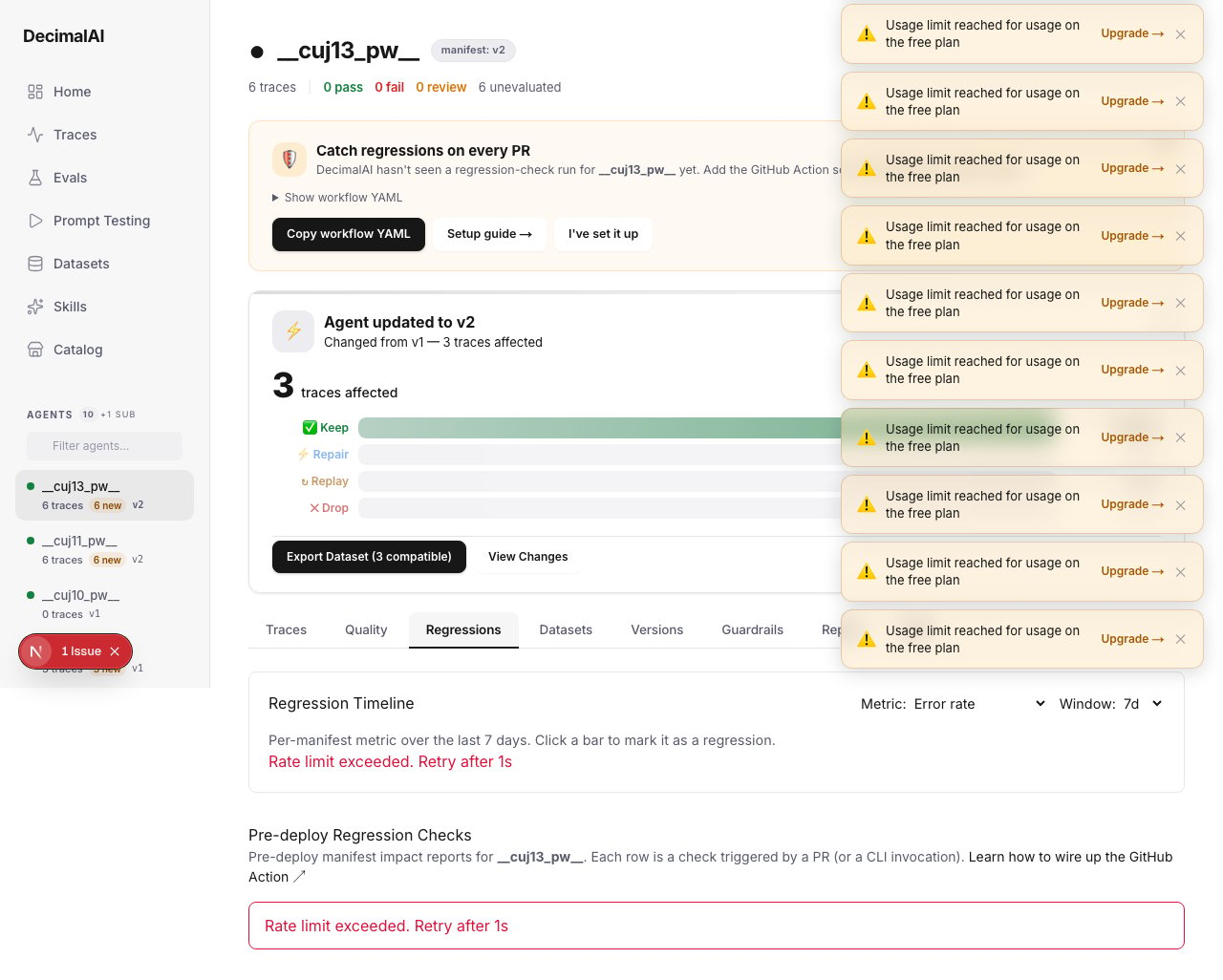
The full impact report renders in the dashboard alongside a regressions tab that lists every check run for the agent:
 ## How severity is determined
For each surface change in the manifest diff, DecimalAI runs a deterministic query against your trace store:
| Surface change | Severity |
| --------------------------------------------------------------------- | ----------------------------------- |
| Tool removed → traces that called this tool | 🔴 HIGH |
| Tool schema added required param → traces missing the param | 🔴 HIGH |
| Tool schema added optional param → traces that called this tool | 🟢 LOW |
| Tool schema removed param → traces that passed the now-removed param | 🟡 MEDIUM |
| Tool added (no historical traces affected) | 🟢 LOW |
| Prompt section rewritten >X% → traces overlapping the changed section | 🟡 MEDIUM |
| Skill removed → traces that activated this skill | 🔴 HIGH |
| Skill modified → traces that activated this skill | 🟡 MEDIUM |
| Model changed → all traces affected | 🟡 MEDIUM (with caveat — see below) |
**Honest caveat for model swaps and large prompt rewrites:** these are changes where structural reasoning can only say "everything may be affected." The impact report will tell you "all N traces at risk" but cannot predict behavioral direction. For a **model swap**, the `behavioral-check` input (preview) closes part of this gap: it re-issues one recorded model call per affected trace against the candidate model and diffs the outputs. It defaults to `mock` (no token spend), and `real` is same-provider only — a stateless single model call, not your agent end-to-end. For large prompt rewrites (and to confirm real-world behavior after merge), we recommend a careful canary deploy and using [post-deploy bisect](/guides/post-deploy-bisect).
## Configuration options
### `with:` parameters on the Action
| Parameter | Default | Description |
| ------------------- | ---------------- | ----------------------------------------------------------------------------------------------------------------------------------------------------------------------------------------------------------------------------------- |
| `api-key` | (required) | Your DecimalAI API key |
| `agent-name` | (required) | Agent name used in `decimalai.init(agent_name=...)` |
| `fail-on` | `high` | When to fail the PR: `high` (any HIGH IMPACT), `medium` (any MEDIUM+), `none` (warn only) |
| `comment-mode` | `update` | `update` (single comment, updated per push) or `new` (new comment per push) |
| `trace-window-days` | (action default) | How many days of production traces to query for impact |
| `behavioral-check` | `mock` | Behavioral verification for model swaps (preview): `off`, `mock` (count eligible calls, no token spend), or `real` (re-issue one recorded model call per affected trace against the candidate and diff outputs; same-provider only) |
### Blocking behavior
The `fail-on` input is the gate. With the default `fail-on: high`, a HIGH IMPACT verdict fails the CI step — you unblock by fixing the PR (re-adding the tool/argument/skill) or by flipping `fail-on` to `medium`/`none` for that run if you've decided the break is acceptable. The PR-blocking is advisory: GitHub branch protection, not DecimalAI, is what ultimately holds the merge.
**Behavioral verification (preview) — ships now.** The `behavioral-check`
input runs behavioral verification for model swaps. The structural check can
only say a model change "may differ"; `behavioral-check: real` re-issues one
recorded model call per affected trace against the candidate model and diffs
the outputs. It's a **stateless single model call**, not your agent
end-to-end. It defaults to `mock` (counts eligible calls, no token spend);
`real` is **same-provider only** and spends tokens. This only runs when the
manifest diff contains a model change.
**Deferred.** Cross-provider model swaps (e.g. OpenAI → Anthropic) and full
end-to-end agent replay are not in this preview. The shipped call-replay
verifies a single recorded model call against the candidate of the **same
provider** — it does not re-run your full agent loop.
## Running outside CI
You can drive the same impact analysis from your laptop, a notebook, or any CI system that isn't GitHub Actions — every snippet is pre-filled with a placeholder agent name and candidate manifest:
```bash CLI theme={null}
# After editing your agent code, register the candidate manifest:
python -c "
import decimalai
decimalai.init()
decimalai.flush_manifest_for_ci(agent_name='support-agent')
"
# Then run the check (auto-discovers the manifest ID from $GITHUB_OUTPUT
# or ./decimal_manifest_id.txt):
decimalai regression-check --agent-name support-agent
# Or pass an explicit manifest ID for any previously-registered version:
decimalai regression-check \
--agent-name support-agent \
--candidate-manifest-id mfst_xyz \
--fail-on medium \
--trace-window-days 60
```
```bash curl theme={null}
curl -X POST https://api.decimal.ai/api/v1/regression-check \
-H "Authorization: Bearer dai_sk_..." \
-H "Content-Type: application/json" \
-d '{
"agent_name": "support-agent",
"candidate_manifest_id": "mfst_xyz",
"trace_window_days": 30
}'
```
Pass `--dry-run` (CLI) — or `?dry_run=true` (curl) — to compute the report without persisting it or consuming your metered quota. Great for exploring "what would happen if I…" scenarios.
## What can go wrong
### "Manifest extraction failed"
Common causes:
* Your init script imports something that requires a real API key, database connection, or other production resource
* A dependency in your `pip install` failed
* A required env var isn't set
**Behavior:** The Action posts a "manifest extraction failed — see logs" warning and **does not block the PR**. Setup issues are not regressions; we won't hold your PR hostage.
**Fix:** Make your `build_agent()` (or equivalent) callable in isolation. Mock or stub anything that needs production resources. The init only needs to register tools, prompts, and models with the SDK — it doesn't need to actually run the agent.
### "First run — no baseline"
Normal on the first PR after installing. The Action records your candidate manifest as the baseline and exits success. Future PRs will diff against this.
### Empty or small impact reports
If the report shows "no traces affected" but you know your change should affect some traffic, check:
* Have you ingested production traces for this agent? Manifest impact analysis needs historical traces to query.
* Is the `agent-name` in your Action config the same as the one passed to `decimalai.init()`? Mismatched names produce empty results.
* Has enough time passed since your manifest changes for traces to accumulate? Fresh changes need traffic.
### Stale baseline
The baseline manifest updates only when you deploy a new manifest to production (registered via the SDK in normal mode). If your baseline is many versions behind your actual production state, your impact reports will look exaggerated. The fix: re-deploy the SDK in production to refresh the baseline.
## How this compares to eval-based regression checks
Other tools (LangSmith, Braintrust, Langfuse) implement regression check by running your eval suite on the new version and comparing pass rates. DecimalAI works fundamentally differently:
| | Eval-driven (other tools) | Manifest-aware (DecimalAI) |
| --------------------------------- | ------------------------------------ | -------------------------------------------------------- |
| Requires writing eval cases | Yes — substantial ongoing work | No — production traces are the test set |
| Requires running your agent in CI | Yes — your CI runs the eval suite | **No** — pure trace-store query |
| Knows the blast radius | No — full eval suite runs every time | Yes — identifies exactly which traces touched the change |
| Catches removed-tool regressions | Only if eval coverage exists | Always |
| Cost per check | Variable (\$) | \<\$0.001 |
| Stochasticity issues | Yes (LLM-graded evals vary by run) | No (deterministic structural query) |
The two approaches are complementary. Use both if you want behavioral verification on the eval surface; use DecimalAI alone if you don't have an eval suite yet.
## FAQ
On the very first run, the candidate becomes the baseline automatically. Verdict is `first_run`, no impacts are flagged. Subsequent PRs are diffed against it.
No. The diff is purely structural — it inspects the manifest content, not LLM outputs. The `medium_risk` and `high_risk` traces it flags can *optionally* be replayed against the candidate, which costs tokens since it re-runs them through the model. The base regression check itself is free in terms of model cost; it counts against your `regression_checks` plan limit.
`fail-on: high` (default) only fails the CI step on `high_risk` verdicts — use this if you want to ship behavior changes deliberately. `fail-on: medium` is stricter — fails on any non-obvious change. Pick based on how aggressive your team wants the gate to be. `fail-on: none` always passes (warn-only mode).
Yes. PR context is best-effort metadata for traceability. The check works on any candidate manifest — pass `--candidate-manifest-id` explicitly to the CLI (`decimalai regression-check`), or POST to `/api/v1/regression-check` from any script.
Evals score the *output* of running your candidate against fixed inputs; the regression check inspects the *structure* of the change to tell you which existing traces are affected — fast, free, no model calls. Most teams run the check on every PR and gate evals to the cases it flags `medium_risk` or higher. See [How this compares to eval-based regression checks](#how-this-compares-to-eval-based-regression-checks) for the full side-by-side.
## What's next
What manifests capture and how diffs work under the hood.
Skills are first-class manifest surfaces — they appear in impact reports.
Use the same manifest awareness for SFT data integrity.
How traces, manifests, evals, and datasets connect.
Action not commenting, or says "no manifest"? Common fixes.
## How severity is determined
For each surface change in the manifest diff, DecimalAI runs a deterministic query against your trace store:
| Surface change | Severity |
| --------------------------------------------------------------------- | ----------------------------------- |
| Tool removed → traces that called this tool | 🔴 HIGH |
| Tool schema added required param → traces missing the param | 🔴 HIGH |
| Tool schema added optional param → traces that called this tool | 🟢 LOW |
| Tool schema removed param → traces that passed the now-removed param | 🟡 MEDIUM |
| Tool added (no historical traces affected) | 🟢 LOW |
| Prompt section rewritten >X% → traces overlapping the changed section | 🟡 MEDIUM |
| Skill removed → traces that activated this skill | 🔴 HIGH |
| Skill modified → traces that activated this skill | 🟡 MEDIUM |
| Model changed → all traces affected | 🟡 MEDIUM (with caveat — see below) |
**Honest caveat for model swaps and large prompt rewrites:** these are changes where structural reasoning can only say "everything may be affected." The impact report will tell you "all N traces at risk" but cannot predict behavioral direction. For a **model swap**, the `behavioral-check` input (preview) closes part of this gap: it re-issues one recorded model call per affected trace against the candidate model and diffs the outputs. It defaults to `mock` (no token spend), and `real` is same-provider only — a stateless single model call, not your agent end-to-end. For large prompt rewrites (and to confirm real-world behavior after merge), we recommend a careful canary deploy and using [post-deploy bisect](/guides/post-deploy-bisect).
## Configuration options
### `with:` parameters on the Action
| Parameter | Default | Description |
| ------------------- | ---------------- | ----------------------------------------------------------------------------------------------------------------------------------------------------------------------------------------------------------------------------------- |
| `api-key` | (required) | Your DecimalAI API key |
| `agent-name` | (required) | Agent name used in `decimalai.init(agent_name=...)` |
| `fail-on` | `high` | When to fail the PR: `high` (any HIGH IMPACT), `medium` (any MEDIUM+), `none` (warn only) |
| `comment-mode` | `update` | `update` (single comment, updated per push) or `new` (new comment per push) |
| `trace-window-days` | (action default) | How many days of production traces to query for impact |
| `behavioral-check` | `mock` | Behavioral verification for model swaps (preview): `off`, `mock` (count eligible calls, no token spend), or `real` (re-issue one recorded model call per affected trace against the candidate and diff outputs; same-provider only) |
### Blocking behavior
The `fail-on` input is the gate. With the default `fail-on: high`, a HIGH IMPACT verdict fails the CI step — you unblock by fixing the PR (re-adding the tool/argument/skill) or by flipping `fail-on` to `medium`/`none` for that run if you've decided the break is acceptable. The PR-blocking is advisory: GitHub branch protection, not DecimalAI, is what ultimately holds the merge.
**Behavioral verification (preview) — ships now.** The `behavioral-check`
input runs behavioral verification for model swaps. The structural check can
only say a model change "may differ"; `behavioral-check: real` re-issues one
recorded model call per affected trace against the candidate model and diffs
the outputs. It's a **stateless single model call**, not your agent
end-to-end. It defaults to `mock` (counts eligible calls, no token spend);
`real` is **same-provider only** and spends tokens. This only runs when the
manifest diff contains a model change.
**Deferred.** Cross-provider model swaps (e.g. OpenAI → Anthropic) and full
end-to-end agent replay are not in this preview. The shipped call-replay
verifies a single recorded model call against the candidate of the **same
provider** — it does not re-run your full agent loop.
## Running outside CI
You can drive the same impact analysis from your laptop, a notebook, or any CI system that isn't GitHub Actions — every snippet is pre-filled with a placeholder agent name and candidate manifest:
```bash CLI theme={null}
# After editing your agent code, register the candidate manifest:
python -c "
import decimalai
decimalai.init()
decimalai.flush_manifest_for_ci(agent_name='support-agent')
"
# Then run the check (auto-discovers the manifest ID from $GITHUB_OUTPUT
# or ./decimal_manifest_id.txt):
decimalai regression-check --agent-name support-agent
# Or pass an explicit manifest ID for any previously-registered version:
decimalai regression-check \
--agent-name support-agent \
--candidate-manifest-id mfst_xyz \
--fail-on medium \
--trace-window-days 60
```
```bash curl theme={null}
curl -X POST https://api.decimal.ai/api/v1/regression-check \
-H "Authorization: Bearer dai_sk_..." \
-H "Content-Type: application/json" \
-d '{
"agent_name": "support-agent",
"candidate_manifest_id": "mfst_xyz",
"trace_window_days": 30
}'
```
Pass `--dry-run` (CLI) — or `?dry_run=true` (curl) — to compute the report without persisting it or consuming your metered quota. Great for exploring "what would happen if I…" scenarios.
## What can go wrong
### "Manifest extraction failed"
Common causes:
* Your init script imports something that requires a real API key, database connection, or other production resource
* A dependency in your `pip install` failed
* A required env var isn't set
**Behavior:** The Action posts a "manifest extraction failed — see logs" warning and **does not block the PR**. Setup issues are not regressions; we won't hold your PR hostage.
**Fix:** Make your `build_agent()` (or equivalent) callable in isolation. Mock or stub anything that needs production resources. The init only needs to register tools, prompts, and models with the SDK — it doesn't need to actually run the agent.
### "First run — no baseline"
Normal on the first PR after installing. The Action records your candidate manifest as the baseline and exits success. Future PRs will diff against this.
### Empty or small impact reports
If the report shows "no traces affected" but you know your change should affect some traffic, check:
* Have you ingested production traces for this agent? Manifest impact analysis needs historical traces to query.
* Is the `agent-name` in your Action config the same as the one passed to `decimalai.init()`? Mismatched names produce empty results.
* Has enough time passed since your manifest changes for traces to accumulate? Fresh changes need traffic.
### Stale baseline
The baseline manifest updates only when you deploy a new manifest to production (registered via the SDK in normal mode). If your baseline is many versions behind your actual production state, your impact reports will look exaggerated. The fix: re-deploy the SDK in production to refresh the baseline.
## How this compares to eval-based regression checks
Other tools (LangSmith, Braintrust, Langfuse) implement regression check by running your eval suite on the new version and comparing pass rates. DecimalAI works fundamentally differently:
| | Eval-driven (other tools) | Manifest-aware (DecimalAI) |
| --------------------------------- | ------------------------------------ | -------------------------------------------------------- |
| Requires writing eval cases | Yes — substantial ongoing work | No — production traces are the test set |
| Requires running your agent in CI | Yes — your CI runs the eval suite | **No** — pure trace-store query |
| Knows the blast radius | No — full eval suite runs every time | Yes — identifies exactly which traces touched the change |
| Catches removed-tool regressions | Only if eval coverage exists | Always |
| Cost per check | Variable (\$) | \<\$0.001 |
| Stochasticity issues | Yes (LLM-graded evals vary by run) | No (deterministic structural query) |
The two approaches are complementary. Use both if you want behavioral verification on the eval surface; use DecimalAI alone if you don't have an eval suite yet.
## FAQ
On the very first run, the candidate becomes the baseline automatically. Verdict is `first_run`, no impacts are flagged. Subsequent PRs are diffed against it.
No. The diff is purely structural — it inspects the manifest content, not LLM outputs. The `medium_risk` and `high_risk` traces it flags can *optionally* be replayed against the candidate, which costs tokens since it re-runs them through the model. The base regression check itself is free in terms of model cost; it counts against your `regression_checks` plan limit.
`fail-on: high` (default) only fails the CI step on `high_risk` verdicts — use this if you want to ship behavior changes deliberately. `fail-on: medium` is stricter — fails on any non-obvious change. Pick based on how aggressive your team wants the gate to be. `fail-on: none` always passes (warn-only mode).
Yes. PR context is best-effort metadata for traceability. The check works on any candidate manifest — pass `--candidate-manifest-id` explicitly to the CLI (`decimalai regression-check`), or POST to `/api/v1/regression-check` from any script.
Evals score the *output* of running your candidate against fixed inputs; the regression check inspects the *structure* of the change to tell you which existing traces are affected — fast, free, no model calls. Most teams run the check on every PR and gate evals to the cases it flags `medium_risk` or higher. See [How this compares to eval-based regression checks](#how-this-compares-to-eval-based-regression-checks) for the full side-by-side.
## What's next
What manifests capture and how diffs work under the hood.
Skills are first-class manifest surfaces — they appear in impact reports.
Use the same manifest awareness for SFT data integrity.
How traces, manifests, evals, and datasets connect.
Action not commenting, or says "no manifest"? Common fixes.